

Body fat calculator
Your body fat percentage tells you something different from your BMI: how much of your weight is fat, rather than how heavy you are for your height. This tool estimates your body fat with the US Navy method (tape measure) or the Deurenberg formula (BMI and age only). Wondering if medically supervised weight loss fits your situation? Take the free check.
- US Navy (male)
- 495 / (1.0324 − 0.19077·log(waist−neck) + 0.15456·log(height)) − 450
Neck: measure just below your Adam's apple, tilting the tape slightly downward.
Waist: measure at navel height, after a normal exhale, without pulling your stomach in.
Hip: measure at the widest point of your hips and buttocks.
Why BMI and body fat measure different things
BMI only looks at weight and height, and doesn't distinguish between fat and muscle mass. Two people with the exact same BMI can look very different physically: one with a lot of muscle and little fat, the other with little muscle and a lot of fat. For most people that difference isn't huge, but for athletes, older adults, and anyone who recently gained or lost a lot of muscle, BMI can be misleading.
Body fat percentage measures directly how much of your body weight is fat tissue, which says more about health risk than BMI alone. Fat around your waist, for example, is more strongly linked to cardiovascular disease and type 2 diabetes than fat elsewhere on your body. Both numbers are useful, but they tell a different story.
Strength athletes with a lot of muscle mass often land in the overweight category on BMI, while their body fat percentage is actually low. Body fat gives a fairer picture of body composition in that case.
How accurate are these formulas
The US Navy method and the Deurenberg formula are both estimates, not exact measurements. The US Navy method typically has a margin of error of around 3 to 4 percentage points versus the gold standard, provided you measure carefully. The Deurenberg formula is somewhat less precise, since it relies entirely on BMI and age without accounting for individual differences in body build.
The gold standard for measuring body fat is a DEXA scan, the same technology used to measure bone density. It's precise, but expensive and not something you do at home. Bio-electrical impedance scales, common at home or at the gym, send a small current through your body and are very sensitive to hydration: just had a drink, worked out or eaten, and the result can shift noticeably.
Don't treat this tool as an exact number, use it to track direction. Measure at the same time of day under the same conditions each time, and changes over time will tell you more than any single result.
What's a healthy body fat percentage by age
Classification by the American Council on Exercise (ACE), shown as male · female
A healthy body fat percentage naturally differs between men and women: women biologically need more essential fat, partly for hormone regulation. Body fat also tends to rise with age even at a stable weight, since muscle mass gradually declines. The ranges below apply to adults and are a general guide, not a hard cutoff.
- Essential fat
- The minimum your body needs to function normally.
- 2-5% · 10-13%
- Athletic
- Typical for dedicated athletes.
- 6-13% · 14-20%
- Fit
- Visible muscle definition.
- 14-17% · 21-24%
- Average
- The most common range for healthy adults.
- 18-24% · 25-31%
- High
- A higher percentage, often linked to increased health risk.
- 25%+ · 32%+
This classification was developed for adults up to around age 60. In older adults a somewhat higher percentage is often considered healthy, since muscle mass naturally declines with age.
Common measuring mistakes
The US Navy method is accurate, provided you measure well. These four mistakes come up most often.
- Tape too tight or too loose
- A tape that presses into your skin, or hangs loose, distorts the reading. It should just touch your skin without pinching.
- Measuring in the wrong spot
- Measure your waist at navel height, your neck just below the Adam's apple, and your hip at its widest point. A few centimeters off already changes the result.
- Measuring after eating or exercise
- A full stomach or a workout can temporarily increase your waist measurement. Measure in the morning, before breakfast, if you can.
- Measuring inconsistently over time
- If you're tracking body fat over several weeks, measure at the same time of day and under the same conditions each time, otherwise you're comparing apples to oranges.
Half a percentage point doesn't say much. Look at the trend over several measurements, not a single result.
Body fat is one piece of the puzzle. Want to know if medically supervised weight loss fits your situation? A doctor and coach can help you figure that out.
Take the free checkGeneral information
about GLP-1 medication.
Below you'll find an overview of the best-known GLP-1 medications. This is general, informational content. Which medication, dosage or treatment is right for you is always determined by a doctor during a personal intake, alongside lifestyle guidance.
Semaglutide at a higher dose, specifically registered for weight management in adults with overweight or obesity.
- Active ingredient
- Semaglutide, a GLP-1 receptor agonist at a higher dose.
- Usage
- Once a week via a subcutaneous injection using a specially designed pen.
- Target group
- For people with obesity (BMI ≥30) or overweight (BMI ≥27) with weight-related conditions.
- How it works
- Mimics the natural GLP-1 hormone, reduces appetite, slows gastric emptying and improves satiety.
- Potential weight loss
- An average of 16.9% in clinical research after 68 weeks, at the highest dose.
- Side effects
- Mainly nausea, gastrointestinal complaints and fatigue. These usually decrease over time.
This medication is available on prescription only and should be used under professional medical supervision. A personal screening and regular check-ins are essential for safe and effective treatment. This medication is not covered by health insurance.
Everything you want to know
about body fat percentage.
- What's a normal body fat percentage for my age?
- For men, an average body fat percentage is between 18 and 24%, for women between 25 and 31%. Body fat tends to rise with age as muscle mass gradually declines. See the full breakdown above for the other categories.
- Is the US Navy method reliable?
- Reasonably reliable, with a margin of error of around 3 to 4 percentage points as long as you measure carefully. The only more precise method is a DEXA scan, which you can't do at home.
- What's the difference between body fat and BMI?
- BMI only looks at weight and height, body fat measures how much of your weight is actually fat. For a fuller picture, also calculate your BMI, the two numbers complement each other.
- How do I lower my body fat percentage?
- A combination of a modest calorie deficit and enough protein works best, since it helps preserve muscle mass while you lose fat. If that's not enough on its own, medical guidance can help.
- Why doesn't the Deurenberg formula need a tape measure?
- The Deurenberg formula estimates your body fat from BMI, age and sex. That's quicker, but somewhat less precise than the US Navy method since it doesn't look at your actual body build.
Blog about medical weight loss
Read our articles about medical weight loss, lifestyle, nutrition, medication, obesity, exercise and healthy living.
Wegovy pil goedgekeurd in Europa: de eerste GLP-1 pil voor gewichtsbeheersing
De Europese Commissie heeft de Wegovy pil goedgekeurd als eerste GLP-1 pil voor gewichtsbeheersing in de EU. Wat is er precies goedgekeurd en wanneer komt de pil naar Nederland?

Orforglipron (Foundayo): wat de GLP-1-pil kan en wanneer hij hier is
De FDA keurde orforglipron op 1 april 2026 goed als Foundayo, de eerste GLP-1-pil zonder eet- of drinkvoorschriften. Wat de ATTAIN-studies laten zien, welke bijwerkingen erbij horen en wanneer het middel in Nederland te verwachten is.
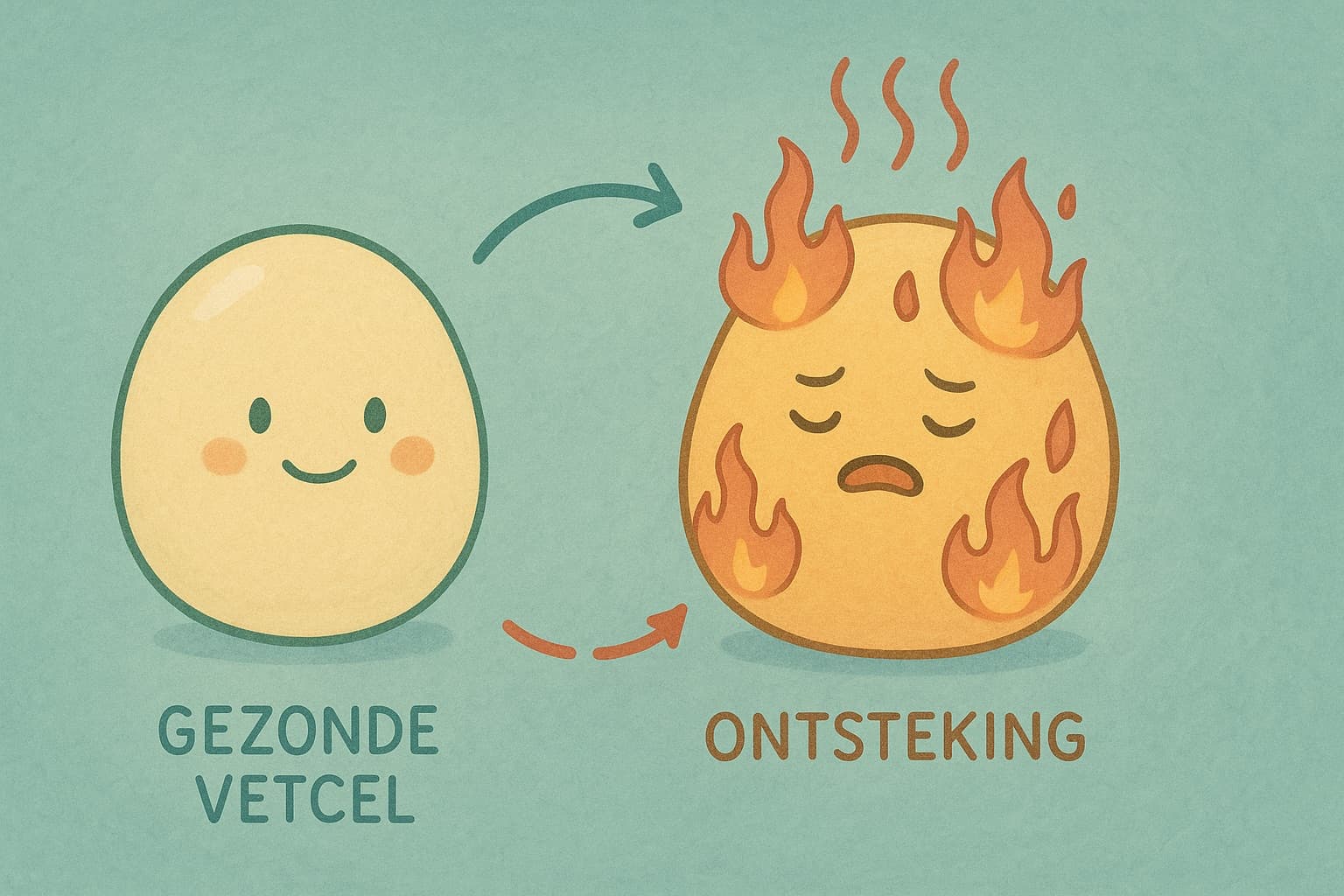
Ontsteking en obesitas: waar start de vicieuze cirkel?
Een diepgaande blik op de complexe relatie tussen obesitas en chronische ontsteking, hoe ze elkaar versterken, en hoe leefstijl en nieuwe behandelingen zoals GLP-1 medicatie deze cirkel kunnen doorbreken.