

What does your body burn at rest?
Your BMR is the foundation for all other calculations. Choose one of the three scientific formulas and instantly see your total daily calorie burn for each activity level.
- Muscle mass
- Muscles burn more calories than fat
- Age
- BMR drops 2-3% per decade from age 30
- Sex
- Men tend to have a higher BMR due to greater muscle mass
- Genetics
- Some people naturally have a faster metabolism
- Hormones
- Thyroid issues can significantly affect BMR
Three ways to estimate the same thing.
Modern and accurate for most people. Our default choice.
10 × kg + 6.25 × cm − 5 × age + 510 × kg + 6.25 × cm − 5 × years − 161The original formula, still in use today but slightly less precise.
88.36 + 13.4 × kg + 4.8 × cm − 5.68 × years447.6 + 9.25 × kg + 3.1 × cm − 4.33 × yearsUses lean body mass. More accurate if you know your body fat percentage.
370 + 21.6 × lean body mass (kg)Increasing your BMR: what actually works
Most "boost your metabolism" advice is nonsense. This isn't.
Every kilogram of muscle burns around 13 kcal extra per day. Strength training is the most effective way to build it.
Protein has a thermic effect of 20–30%. Your body uses energy just to digest it.
Too little sleep disrupts your hormones and lowers your BMR. Aim for 7–9 hours a night.
Extreme calorie deficits can permanently lower your BMR. Your body switches into conservation mode.
Some people have a naturally low BMR, or one that has dropped after years of dieting. Losing weight then becomes extra difficult. Medically supervised weight loss with GLP-1 medication is often a better path than yet another strict diet.
Find out if you qualifyGeneral information
about GLP-1 medication.
Below you'll find an overview of the best-known GLP-1 medications. This is general, informational content. Which medication, dosage or treatment is right for you is always determined by a doctor during a personal intake, alongside lifestyle guidance.
Semaglutide at a higher dose, specifically registered for weight management in adults with overweight or obesity.
- Active ingredient
- Semaglutide, a GLP-1 receptor agonist at a higher dose.
- Usage
- Once a week via a subcutaneous injection using a specially designed pen.
- Target group
- For people with obesity (BMI ≥30) or overweight (BMI ≥27) with weight-related conditions.
- How it works
- Mimics the natural GLP-1 hormone, reduces appetite, slows gastric emptying and improves satiety.
- Potential weight loss
- An average of 16.9% in clinical research after 68 weeks, at the highest dose.
- Side effects
- Mainly nausea, gastrointestinal complaints and fatigue. These usually decrease over time.
This medication is available on prescription only and should be used under professional medical supervision. A personal screening and regular check-ins are essential for safe and effective treatment. This medication is not covered by health insurance.
Everything you want to know
about BMR.
- What exactly is BMR?
- Your basal metabolic rate is the number of calories your body burns at complete rest, purely to keep basic functions going, like breathing, your heartbeat, and cell repair.
- What's the difference between BMR and TDEE?
- BMR is the number of calories your body burns at rest. TDEE is your total daily burn, including movement and exercise. TDEE = BMR × activity factor.
- Which formula should I use?
- For most people, Mifflin-St Jeor is the go-to. If you know your body fat percentage, Katch-McArdle is more accurate. Harris-Benedict is a classic, but slightly less precise.
- Is my BMR really as low as the formula says?
- It could be. Formulas are estimates and can be off by up to 10%. For a precise measurement, you'd need indirect calorimetry at a sports lab or clinic.
- Can my BMR change as I lose weight?
- Yes. The less you weigh, the fewer calories you burn at rest. After significant weight loss, your BMR will be lower than before. Preserving muscle mass helps limit this effect.
- Does long-term dieting lower my BMR?
- Yes, this is called metabolic adaptation. Your body shifts into conservation mode. A moderate deficit (500 kcal) combined with strength training and enough protein helps limit this.
- Does everyone have a BMR?
- Yes. Every living body burns calories. Even in a coma, your body needs energy to keep basic functions going.
- Can I eat below my BMR?
- It's not recommended. Eating below your BMR leads to muscle loss, fatigue, and a lasting slowdown in metabolism. Only do this under medical supervision.
Blog about medical weight loss
Read our articles about medical weight loss, lifestyle, nutrition, medication, obesity, exercise and healthy living.

Wegovy pil goedgekeurd in Europa: de eerste GLP-1 pil voor gewichtsbeheersing
De Europese Commissie heeft de Wegovy pil goedgekeurd als eerste GLP-1 pil voor gewichtsbeheersing in de EU. Wat is er precies goedgekeurd en wanneer komt de pil naar Nederland?

Orforglipron (Foundayo): wat de GLP-1-pil kan en wanneer hij hier is
De FDA keurde orforglipron op 1 april 2026 goed als Foundayo, de eerste GLP-1-pil zonder eet- of drinkvoorschriften. Wat de ATTAIN-studies laten zien, welke bijwerkingen erbij horen en wanneer het middel in Nederland te verwachten is.
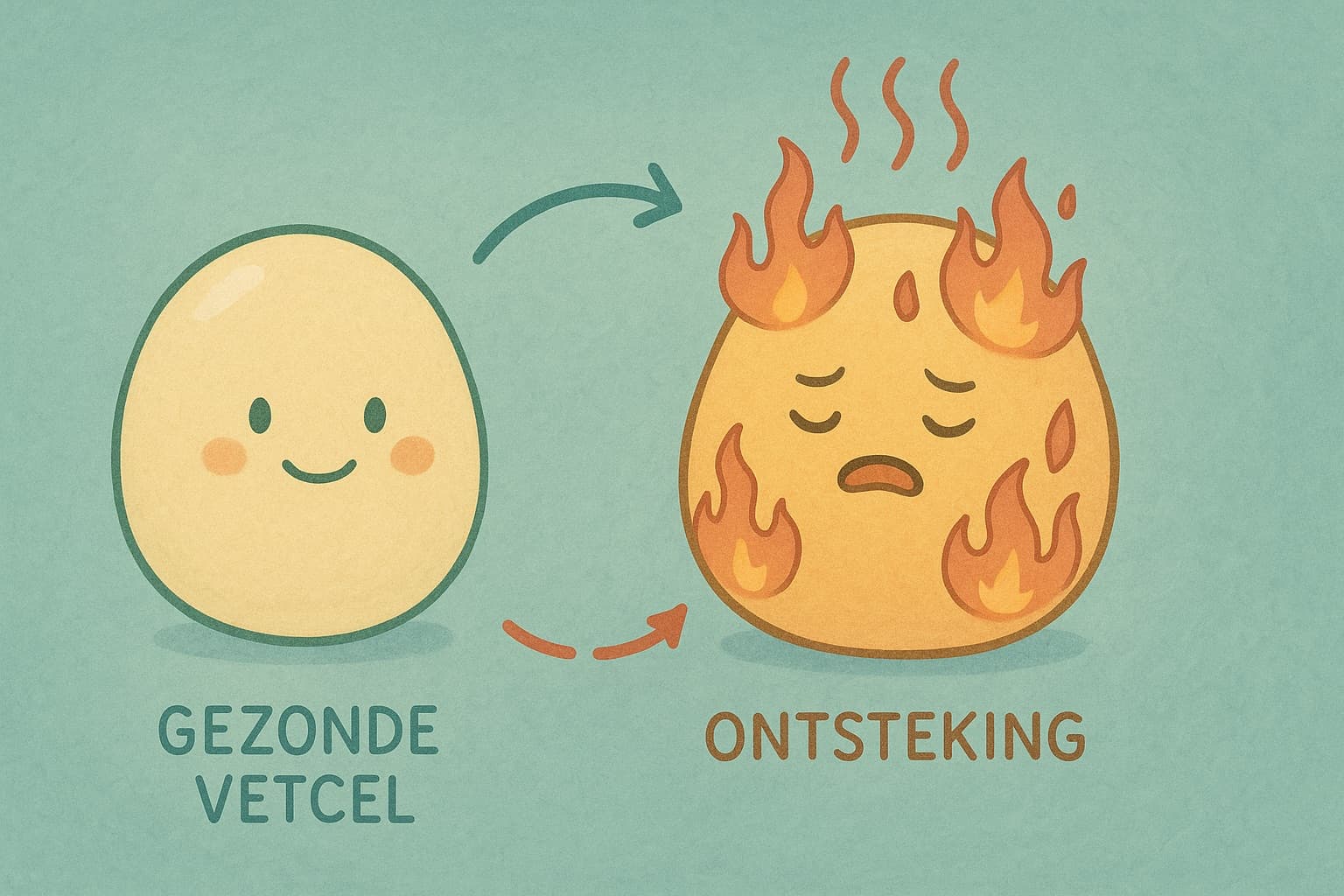
Ontsteking en obesitas: waar start de vicieuze cirkel?
Een diepgaande blik op de complexe relatie tussen obesitas en chronische ontsteking, hoe ze elkaar versterken, en hoe leefstijl en nieuwe behandelingen zoals GLP-1 medicatie deze cirkel kunnen doorbreken.