

Calorie deficit calculator
A calorie deficit is the foundation of healthy weight loss: consistently taking in a bit less energy than you burn. This tool calculates your BMR and TDEE and shows how many kcal you can eat per day at a pace you can actually sustain. If it's not enough on its own, medical guidance can help.
- Target kcal
- TDEE minus daily deficit
How a calorie deficit works
Every day you burn energy: for breathing, digestion, thinking and moving. That total is your TDEE, your total daily energy expenditure. Eat consistently less than your TDEE and a calorie deficit forms, so your body draws the difference from stored energy, mostly fat tissue. The principle is simple; sticking with it is sometimes the hard part.
Your TDEE has two parts: your BMR, the energy you burn at complete rest for your organs and basic functions, and the extra burn from movement and daily activity. This tool first calculates your BMR with the Mifflin-St Jeor formula, multiplies it by your activity level to get your TDEE, and subtracts the deficit that matches your chosen pace.
A bigger deficit feels like a shortcut to faster results, but prolonged undereating brings more hunger and less energy, and it raises the odds you'll quit. A deficit you can stick with beats one you abandon after two weeks.
Why 7,700 kcal per kilo is a rule of thumb
The 7,700 kcal per kilogram figure comes from Max Wishnofsky's 1958 research into the energy content of human fat tissue. Convert that to a week and you get the deficits shown above: 275 kcal per day for 0.25 kg, up to 1,100 kcal per day for 1 kg a week.
That math is a rule of thumb, not a law of nature. In practice, the pace of weight loss often flattens over time, even with an unchanged deficit. That's called metabolic adaptation: your body lowers its energy use in response to weight loss, partly because a lighter body costs less energy to run and partly because everyday spontaneous movement tends to drop without you noticing. That's not a reason to quit, just to adjust your expectations.
Many calculators hide this and show a straight line to your goal weight. We'd rather show how it actually works: the first weeks often move fast, then the pace slows down. That's normal, not a failure on your part.
Common mistakes with a calorie deficit
A deficit sounds simple, but these four pitfalls show up most often for people who get stuck.
- A far too large deficit
- More than 1,000 kcal a day feels tempting for quick results, but it often leads to muscle loss, extreme hunger and giving up over time.
- Relying on willpower alone
- Sticking with a deficit works better with structure, like fixed meal times, enough protein and enough sleep, than with sheer determination.
- Weekend compensation
- Strict on weekdays, then making up for it all weekend. That can wipe out your entire weekly deficit without you realizing it.
- Underestimating calories
- Sauces, drinks and snacks all count. They're the most common reason a deficit on paper turns out not to be one in practice.
Recognize one or more of these patterns? The problem is usually not the formula, it's the execution.
When a deficit isn't enough
A calorie deficit works, but not equally easily for everyone. The longer you've been trying to lose weight, the more your body may have adapted to dieting, and the stronger the compensation mechanisms. Hormonal factors, medication use and how much weight you want to lose all play a role too. Getting stuck despite a consistent deficit isn't a matter of not enough discipline.
Struggling with a deficit alone? Here's how medical guidance helps. A doctor and coach work with you on your lifestyle, and where appropriate, on GLP-1 medication that supports your appetite and sense of fullness.
Take the free checkGeneral information
about GLP-1 medication.
Below you'll find an overview of the best-known GLP-1 medications. This is general, informational content. Which medication, dosage or treatment is right for you is always determined by a doctor during a personal intake, alongside lifestyle guidance.
Semaglutide at a higher dose, specifically registered for weight management in adults with overweight or obesity.
- Active ingredient
- Semaglutide, a GLP-1 receptor agonist at a higher dose.
- Usage
- Once a week via a subcutaneous injection using a specially designed pen.
- Target group
- For people with obesity (BMI ≥30) or overweight (BMI ≥27) with weight-related conditions.
- How it works
- Mimics the natural GLP-1 hormone, reduces appetite, slows gastric emptying and improves satiety.
- Potential weight loss
- An average of 16.9% in clinical research after 68 weeks, at the highest dose.
- Side effects
- Mainly nausea, gastrointestinal complaints and fatigue. These usually decrease over time.
This medication is available on prescription only and should be used under professional medical supervision. A personal screening and regular check-ins are essential for safe and effective treatment. This medication is not covered by health insurance.
Everything you want to know
about a calorie deficit.
- How many calories should I eat to lose weight?
- That depends on your TDEE and the pace at which you want to lose weight. A common deficit is 500 to 550 kcal a day, roughly 0.5 kg a week. Fill in the calculator above for a number tailored to you, or first check your calorie needs without a deficit.
- Is a 500-calorie deficit per day safe?
- For most adults, yes, as long as your daily intake stays above the safe floor of 1,200 kcal for women and 1,500 kcal for men. If that would drop you below it, choose a gentler pace or talk to a doctor.
- Why am I not losing weight despite a calorie deficit?
- Often the real deficit is smaller than you think, for example due to underestimated calories or weekend compensation. Your metabolism can also slow over time. Still stuck after months? Medical guidance can help find the cause.
- How long does it take to lose 10 kg with a calorie deficit?
- At 0.5 kg a week, 10 kg takes about 20 weeks, roughly 5 months. At a gentler pace of 0.25 kg a week, that's about 40 weeks. How realistic that is for you depends on your starting weight and BMI.
- What's the difference between BMR and TDEE?
- Your BMR is the energy you burn at complete rest. Your TDEE adds the energy for movement and daily activity on top. This tool calculates your BMR first and scales it to your TDEE, or calculate your BMR on its own.
Blog about medical weight loss
Read our articles about medical weight loss, lifestyle, nutrition, medication, obesity, exercise and healthy living.

Wegovy pil goedgekeurd in Europa: de eerste GLP-1 pil voor gewichtsbeheersing
De Europese Commissie heeft de Wegovy pil goedgekeurd als eerste GLP-1 pil voor gewichtsbeheersing in de EU. Wat is er precies goedgekeurd en wanneer komt de pil naar Nederland?

Orforglipron (Foundayo): wat de GLP-1-pil kan en wanneer hij hier is
De FDA keurde orforglipron op 1 april 2026 goed als Foundayo, de eerste GLP-1-pil zonder eet- of drinkvoorschriften. Wat de ATTAIN-studies laten zien, welke bijwerkingen erbij horen en wanneer het middel in Nederland te verwachten is.
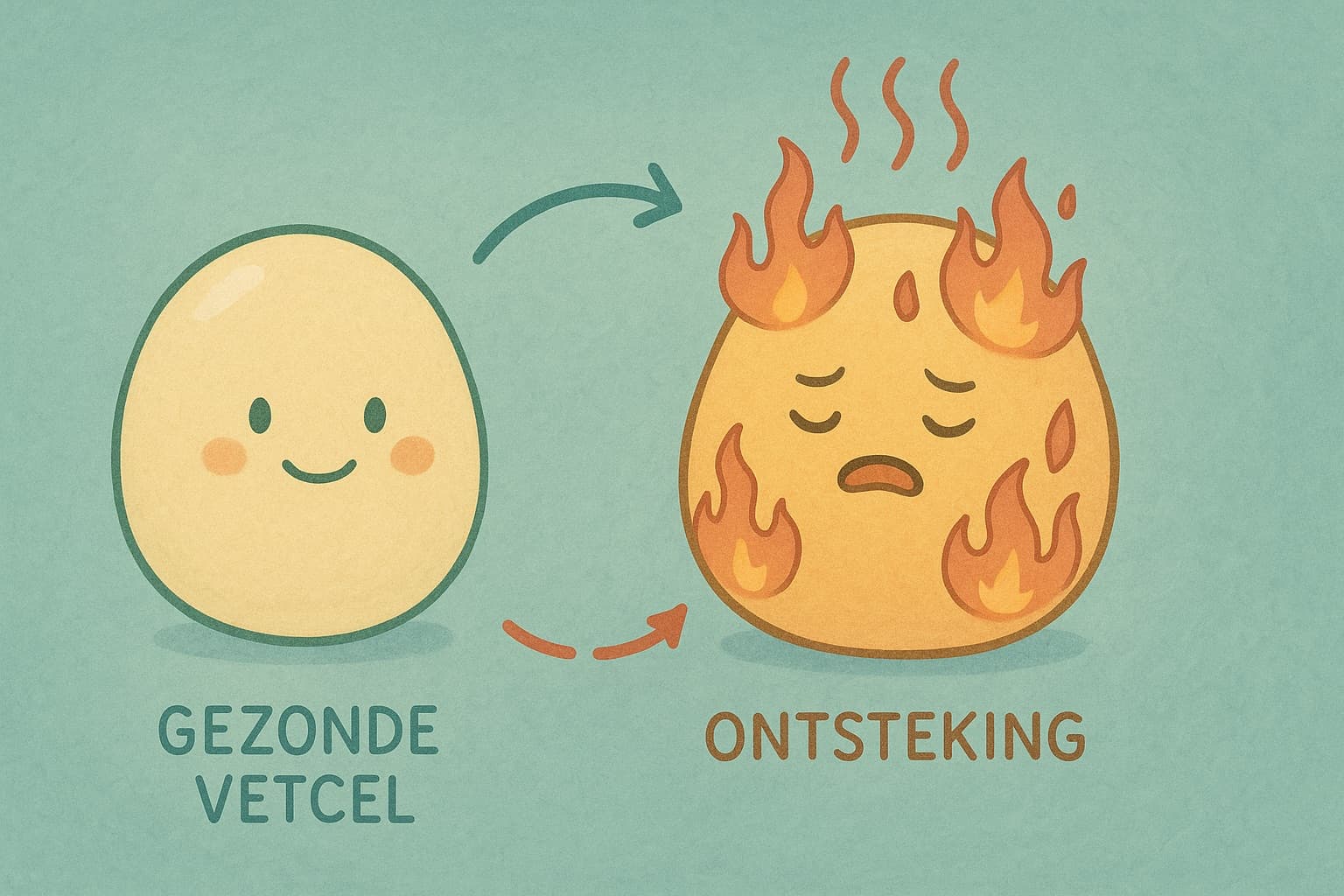
Ontsteking en obesitas: waar start de vicieuze cirkel?
Een diepgaande blik op de complexe relatie tussen obesitas en chronische ontsteking, hoe ze elkaar versterken, en hoe leefstijl en nieuwe behandelingen zoals GLP-1 medicatie deze cirkel kunnen doorbreken.