

GLP-1: what it is and how it works for weight loss
GLP-1 is a hormone your gut makes itself after you eat. Medicines that mimic that hormone have been used for a few years now in type 2 diabetes and in obesity. This page sets out what GLP-1 actually is, how those medicines work, what you can expect and where the limits lie.
The short answer
GLP-1 stands for glucagon-like peptide-1, a hormone released in your gut after a meal that lets your body know you have had enough. GLP-1 agonists are medicines that act on the same receptor and hold that signal for far longer. They are prescription only and belong to a treatment with proper guidance, not to a short course you do for a while.
What is GLP-1?
GLP-1 is an incretin hormone. Special cells in your gut wall release it as soon as food arrives. The hormone travels through your blood and sets several things in motion at once: the pancreas makes more insulin, the liver releases less sugar, your stomach passes food on more slowly, and in your brain the feeling of fullness is switched on.
Your own GLP-1 is broken down again within a few minutes. That is exactly the difference with the medicines: they are built to last much longer, from a day to a week. So the signal that you have had enough stays on, including at moments when your body no longer gives it by itself.
In the consulting room and in the news you hear different names used side by side: GLP-1, GLP-1 agonist, GLP-1 receptor agonist, incretin mimetic. They all refer to the same principle. GLP-1 is the hormone, the rest are the medicines that mimic it.
How do GLP-1 agonists work?
Four effects at once, and they reinforce each other. That explains why these medicines work differently from earlier weight-loss medication, which usually pressed a single button.
Less hunger
GLP-1 acts on areas of the brain that regulate hunger and fullness. Many people notice this most in the urge to eat between meals falling away.
Feeling full for longer
The stomach passes food on to the intestine more slowly. A meal therefore stays with you longer and you feel full sooner.
More insulin after a meal
The pancreas makes more insulin, but only when your blood sugar rises. That is why the chance of a hypo is small when it is used without other diabetes medication.
Less sugar from the liver
The hormone glucagon is suppressed, so the liver releases less sugar into your blood. That is the reason these medicines were first used in type 2 diabetes.
How strong each effect is differs per medicine and per person. Some medicines also act on other hormone receptors, which makes the picture different for each one.
Which GLP-1 medicines exist?
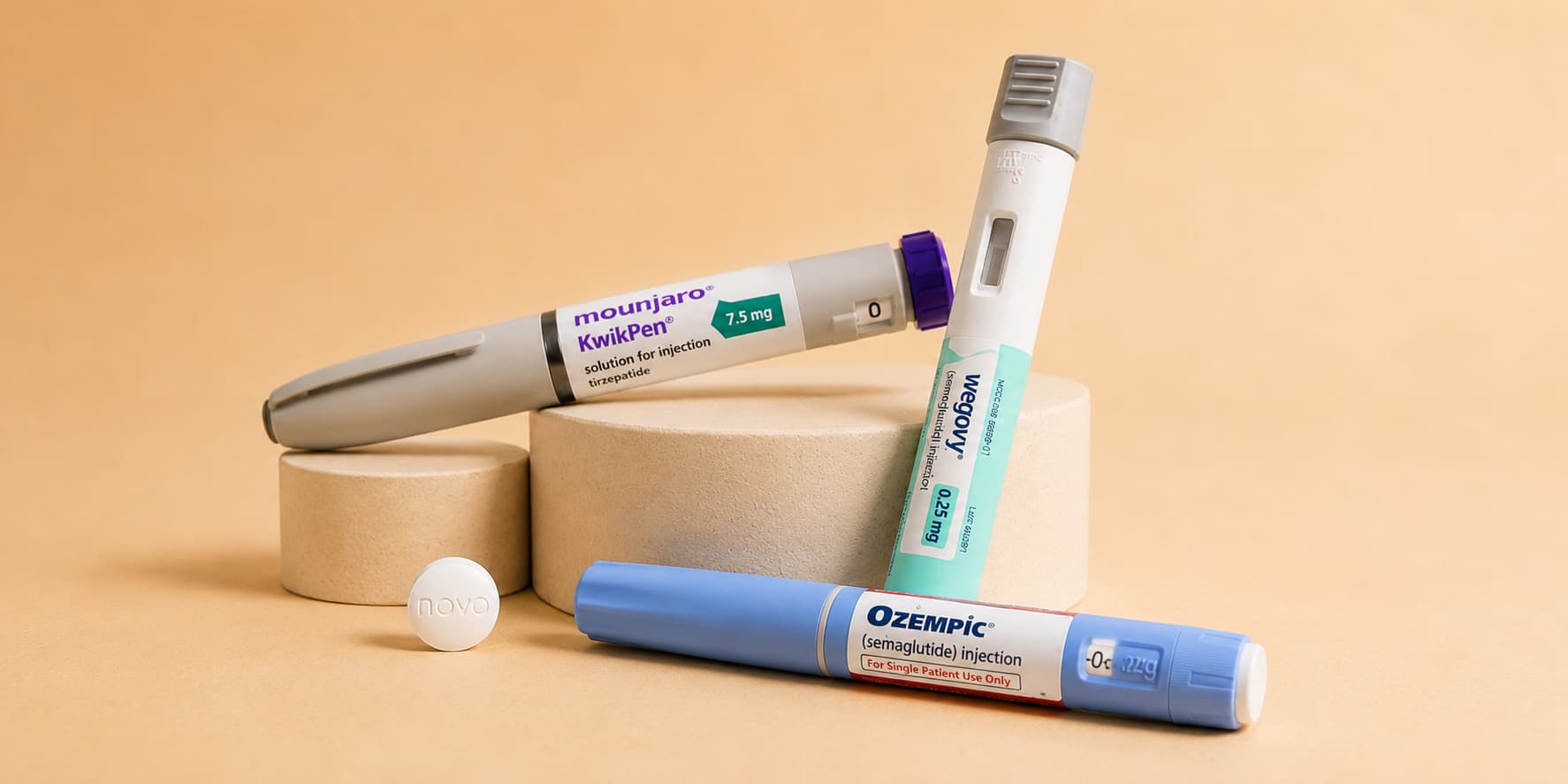
Below are the medicines people ask about most in the Netherlands. They differ in active substance, in how they are taken and in what they are licensed for. A licence for type 2 diabetes does not mean a medicine is also approved for weight treatment, and the other way round.
Wegovy
- Active substance
- Semaglutide
- How it is taken
- Injection, once a week
- In the Netherlands
- Prescription only
The same active substance as Ozempic, but licensed for weight treatment in obesity and in overweight with an accompanying condition.
Mounjaro
- Active substance
- Tirzepatide
- How it is taken
- Injection, once a week
- In the Netherlands
- Prescription only
Acts not only on the GLP-1 receptor but also on the GIP receptor. Strictly speaking a dual agonist, then, although in everyday use it is grouped under GLP-1.
Ozempic
- Active substance
- Semaglutide
- How it is taken
- Injection, once a week
- In the Netherlands
- Prescription only
Licensed for type 2 diabetes. The medicine that made GLP-1 known to the general public.
Saxenda
- Active substance
- Liraglutide
- How it is taken
- Injection, daily
- In the Netherlands
- Prescription only
The oldest of the group and the only one you take every day. Licensed for weight treatment.
Rybelsus
- Active substance
- Semaglutide
- How it is taken
- Tablet, daily
- In the Netherlands
- Prescription only
The first GLP-1 agonist in tablet form. Licensed for type 2 diabetes, not for weight treatment.
Wegovy tablet
- Active substance
- Semaglutide
- How it is taken
- Tablet, daily
- In the Netherlands
- Not yet available
Semaglutide in tablet form, at a dose aimed at weight management. Received a European marketing authorisation in July 2026, but is not in Dutch pharmacies yet.
Orforglipron
- Active substance
- Orforglipron
- How it is taken
- Tablet, daily
- In the Netherlands
- Not yet licensed
Built differently from the other medicines: not a protein but a small molecule, so it needs no refrigeration. Still under study.
Whether a medicine suits you depends on your health, your medical history and the medicines you already take. That judgement is made by a doctor, not by a comparison table.
Injection or tablet?
Most GLP-1 medication is an injection, and there is a reason for that. Semaglutide and liraglutide are proteins. Your stomach juices break proteins down, so in tablet form almost nothing reaches your blood without added excipients.
Injection
- Once a week, or daily with liraglutide
- Under the skin of the abdomen, thigh or upper arm
- It is a thin needle in a pre-filled pen
- The most experience and the widest choice
Tablet
- Every day at a fixed time, on an empty stomach
- Wait at least thirty minutes before eating or drinking
- The choice in the Netherlands is still small
- Handy if you dread needles
So the oral version is not a weaker one, it is a different way of taking the medicine with conditions of its own. If you want to see them side by side, the full comparison is on the page about oral GLP-1 medication.
What can you realistically expect?
GLP-1 treatment always starts low and is built up step by step. That is not caution for the sake of caution, it is how side effects are kept manageable. Broadly, it runs in four phases.
Week 1 to 4
Starting up
You begin on the lowest dose. That dose is not there to make you lose weight but to let your body get used to it. Most stomach and bowel complaints come up in these weeks and often ease off afterwards.
Month 2 and 3
Building up
The dose goes up step by step, and only if the previous step went well. If you have complaints, you stay on a step longer or go back a step. The effect on your appetite becomes clearer in this period.
Month 4 to 6
Maintenance
You are on a dose that fits. What the medicine does for you can now be judged properly. This is also the point at which it becomes clear whether the treatment is having the desired effect.
After that
Keeping it up
Obesity is a chronic condition and GLP-1 medication treats it for as long as you take it. If you stop, in most cases your appetite comes back and often some of the weight too. What you build up in the meantime in habits, muscle mass and exercise determines how much you hold on to.
Why experiences differ so much
Results vary widely, and that is not down to the medicine alone. Starting weight, age, other conditions, medication use, sleep, protein intake and exercise all play a part. How much someone loses on average in a study therefore says little about what you can expect. The study figures for each medicine are on that medicine's own page.
Side effects and risks
GLP-1 agonists are not harmless medicines. They are prescription only, and there is a reason for that. Most side effects are mild and temporary, but there are situations in which you contact a doctor straight away.
Common
- Nausea, especially in the first weeks and after a dose increase
- Constipation or, conversely, diarrhoea
- Vomiting and belching
- Stomach ache and a bloated feeling
- Headache and tiredness
- Less appetite, including for things you would normally fancy
Contact a doctor straight away if you have
- Severe, persistent stomach pain that radiates to your back, possibly pancreatitis
- Persistent vomiting that stops you drinking enough
- Pain in the upper right of your abdomen, nausea and yellowing of the skin, possibly gallstones
- Problems with your vision if you have diabetes
Beyond side effects, keeping muscle matters. With rapid weight loss, part of what you lose can be muscle rather than fat. Enough protein and strength training during treatment limit that, and with good guidance the loss usually stays confined to fat. The full list of side effects is in each medicine’s official leaflet.
Who is GLP-1 medication meant for?
These medicines are licensed for specific situations. They are not meant for people who want to lose a few kilos, and a doctor will not prescribe them for that either.
May be eligible
- A BMI of 30 or higher
- A BMI of 27 or higher combined with, for example, high blood pressure, type 2 diabetes, sleep apnoea or high cholesterol
- Earlier serious attempts through lifestyle that did not deliver enough
- A willingness to combine the treatment with nutrition, exercise and guidance
Not suitable in case of
- Pregnancy, breastfeeding or wanting to become pregnant in the near future
- Medullary thyroid cancer in the family or MEN2 syndrome
- A previous episode of pancreatitis
- Serious stomach or bowel conditions such as gastroparesis
- An eating disorder now or in the past, without discussing it with your treating doctor
This is a shortened version. A doctor weighs up your full medical situation, including the medicines you already take.
Is GLP-1 medication reimbursed?
Sometimes. For type 2 diabetes there is a reimbursement scheme with conditions attached. For weight treatment, reimbursement is limited to a small group and strict criteria apply, including a combined lifestyle intervention that has been completed first.
In practice, most people who use these medicines for weight treatment pay for them themselves. Conditions also change from year to year, so check your policy and the current scheme with your health insurer.
Frequently asked questions about GLP-1
The questions we get asked most, in the words people use to ask them.
Want to know whether this fits you?
Fill in the questionnaire and a BIG-registered doctor will assess whether treatment with medication is responsible in your situation. You are not committing to anything.
This page was compiled and reviewed by the Lean Clinic medical team, AGB 22222155.
Blog about medical weight loss
Read our articles about medical weight loss, lifestyle, nutrition, medication, obesity, exercise and healthy living.

Foundayo-pil (orforglipron): positief Europees advies
De Foundayo-pil (orforglipron) kreeg een positief Europees advies. Wat betekent dit voor goedkeuring, prijs en beschikbaarheid in Nederland? Lees de status.
Wegovy pil goedgekeurd in Europa: de eerste GLP-1 pil voor gewichtsbeheersing
De Europese Commissie heeft de Wegovy pil goedgekeurd als eerste GLP-1 pil voor gewichtsbeheersing in de EU. Wat is er precies goedgekeurd en wanneer komt de pil naar Nederland?

Orforglipron en gewichtsverlies: de ATTAIN-studies uitgelegd
Hoeveel gewichtsverlies geeft orforglipron? Lees wat ATTAIN-1 laat zien, waarom onderzoekspercentages verschillen en wat de resultaten wel en niet zeggen.